


 Duration
  Commencing
 The Master of Counselling is a two-year course, and is available on both a full time and part time basis.
Skills are developed alongside critically reflective practice that is applied to substantial real-world counselling experience.
Students in the Master of Counselling are exposed to a range of theories and encouraged to develop a holistic approach to counselling based on the understanding that the human person is an integrated being and that no one approach to counselling has all the answers or is the right approach for every client. In the Master of Counselling, you will develop an intentionally integrated understanding of the human person, the basis of human difficulties, and processes of change, growth and healing.
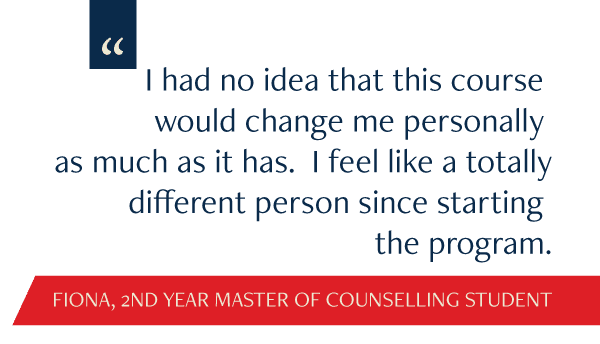
Students will learn to implement a process that holds the potential to mobilise change for clients. Built on trauma-informed principles, this process-based approach of the course then becomes the basis of theoretical integration. There is a strong emphasis on developing the personality of the counsellor. This includes valuing the well-being of the counsellor.
The Master of Counselling is designed to equip student counsellors with the knowledge, skills and experience necessary to work ethically, sensitively, inclusively and respectfully with clients from diverse backgrounds
As a ‘first training’ course, the Master of Counselling is not available to students who already hold a PACFA-accredited qualification, such as a Bachelor of Counselling from a PACFA-accrediting institution. However, if you have completed a non-PACFA accredited course or partial study we may be able to help complete your studies with our accredited course, subject to meeting PACFA training standards.
Successful engagement in the Counselling profession requires a level of personal maturity and self-awareness. PACFA (Psychotherapy and Counselling Federation of Australia) therefore recommends that current and prospective Master of Counselling students are assessed for their personal growth and likely suitability for the Counselling profession. Entry to the Master of Counselling is thus subject not only to academic requirements but also personal suitability as assessed through an interview, a personal statement and referee reports.
Sandy’s Story

Admission Criteria
COURSE ADMISSION CRITERIA
I am an applicant with:
RECENT SECONDARY EDUCATION
Applicants with recent secondary education are not eligible for entry to this course.
VOCATIONAL EDUCATION AND TRAINING (VET) STUDY
Applicants with vocational education and training (VET) study are not eligible for admission to this course.
HIGHER EDUCATION STUDY
Applicants with a Bachelor degree in any field (non-PACFA accredited) are eligible for admission to this course.
WORK AND LIFE EXPERIENCE
Applicants with work and life experience are not eligible for admission to this course.
ENGLISH LANGUAGE PROFICIENCY
Applicants for whom English is not their first language must provide certified documentary evidence that their secondary schooling, or tertiary studies of at least one year, was conducted in the English language or they have satisfactory results in an acceptable English Language Proficiency examination (see table below). Results are to be no more than two years old as at the commencement of the course.
| EXAMINATION | Minimum Requirement |
|---|---|
| IELTS (Academic) | 6.5 (at least 6.0 in all subtests) |
| PTE (Academic) | 59 (at least 51 in all subtests) |
| TOEFL (PBT) | 577 |
| TOEFL (IBT) | 90 (at least 16 in Listening, Reading; 21 in Writing; 18 in Speaking) |

WHAT TO EXPECT
Our expert teaching staff will inspire you to think creatively, be curious and innovate.
Flexible delivery
Choose a part-time or full-time program to suit your circumstances and lifestyle. Part-time students should note some classes may be scheduled during the day.
Capacity to make a meaningful contribution
CHC’s commitment to producing graduates with the capacity to make a meaningful contribution to their clients’ growth and wellbeing involves the strong emphasis on the acquisition and practice of counselling skills.
Although the Master of Counselling is highly experiential in nature with a strong emphasis on the development of the person of the counsellor, it also values and prioritise academic rigour and the importance of staying up-to-date with emerging trends and findings relating to the fields of counselling and psychotherapy. This includes underpinning all aspects of the counselling program with the latest research on interpersonal neurobiology and mental health and encouraging students to engage with counselling research.
Professional recognition
The Master of Counselling is accredited by the Psychotherapy and Counselling Federation of Australia (PACFA). This means that graduates can become Graduate Members of PACFA member organisations including the Christian Counsellors Association of Australia (CCAA) and Queensland Counsellors Association (QCA).
As of 2024, the Master of Counselling will be accredited by the Australian Counselling Association (ACA.) Please refer to the ACA website for the most up to date information.
Course Structure
The Master of Counselling consists of 16 units – 12 core Counselling units, 3 elective Counselling units and 1 unit in research methods.
Master of Counselling students also complete 200 practicum hours (embedded in the units CO667-CO670), 20 hours of their own counselling, 5 site visits to counselling organisations and 15 hours of external professional development events as part of the Master of Counselling. Students who wish to engage in a practicum placement in the area of Child and Adolescent Counselling, or to engage in a practicum placement involving children and young people under the age of 18, must apply for a Blue Card (or equivalent) within the first six months of starting their course.
Students who intend to engage in a practicum placement involving individuals or groups other than children and young people under the age of 18 must make completed a criminal history check prior to engaging in the associated practicum placement.
In planning their course, students must consult the Social Sciences Courses Guide for information regarding course rules and requirements, including unit prerequisite requirements.
Elective Units
Fees & Scholarships
FEES
SCHOLARSHIPS
CHC has a number of scholarships available in particular course areas to help students who are coming to CHC as school-leavers.
The Government also provides some financial assistance to students to help the transition into study.
Further information about scholarships and government financial assistance is available below.
CONTACT US
We want to make sure you’re getting all the relevant and helpful information to ensure you are best informed about your higher education pathway.
A staff member will be in touch to help with your questions.